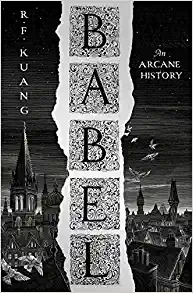
Traduttore, traditore: An act of translation is always an act of betrayal.1828. Robin Swift, orphaned by cholera in Canton, is brought to London by the mysterious Professor Lovell. There, he trains for years in Latin, Ancient Greek, and Chinese, all in preparation for the day he’ll enroll in Oxford University’s prestigious Royal Institute of Translation—also known as Babel.Babel is the world's center for translation and, more importantly, magic. Silver working—the art of manifesting the meaning lost in translation using enchanted silver bars—has made the British unparalleled in power, as its knowledge serves the Empire’s quest for colonization.For Robin, Oxford is a utopia dedicated to the pursuit of knowledge. But knowledge obeys power, and as a Chinese boy raised in Britain, Robin realizes serving Babel means betraying his motherland. As his studies progress, Robin finds himself caught between Babel and the shadowy Hermes Society, an organization dedicated to stopping imperial …
Traduttore, traditore: An act of translation is always an act of betrayal.1828. Robin Swift, orphaned by cholera in Canton, is brought to London by the mysterious Professor Lovell. There, he trains for years in Latin, Ancient Greek, and Chinese, all in preparation for the day he’ll enroll in Oxford University’s prestigious Royal Institute of Translation—also known as Babel.Babel is the world's center for translation and, more importantly, magic. Silver working—the art of manifesting the meaning lost in translation using enchanted silver bars—has made the British unparalleled in power, as its knowledge serves the Empire’s quest for colonization.For Robin, Oxford is a utopia dedicated to the pursuit of knowledge. But knowledge obeys power, and as a Chinese boy raised in Britain, Robin realizes serving Babel means betraying his motherland. As his studies progress, Robin finds himself caught between Babel and the shadowy Hermes Society, an organization dedicated to stopping imperial expansion. When Britain pursues an unjust war with China over silver and opium, Robin must decide…Can powerful institutions be changed from within, or does revolution always require violence?
What if the technology of the Industrial Revolution was different
Aucune note
Not my usual but I’m glad I checked it out. The alternate history was interesting and the protagonist’s viewpoint was enlightening. Overall a good read.
Great themes, good characters, and thoughtful writing
Aucune note
What first struck me was how this book used a smidge of magic to allow certain aspects of themes to be easier to comprehend. The writing does something with themes where it makes them recognizable and able to be investigated in more profound ways by shearing off the sides, so to speak. Yet while I noticed this up front, I was surprised how deep the book went as it reached its zenith and turned toward a conclusion. There were comments about colonialism and empire that I recognized, but the way they were delved into thanks to the aforementioned tactic struck me more deeply than I could have expected. The characters, despite being somewhat symbolic in their deployment, also grew on me immensely. It made me think, and it made my eyes tear up a few times. And that's without mentioning all the fun translation, history, and cultural movement details the …
What first struck me was how this book used a smidge of magic to allow certain aspects of themes to be easier to comprehend. The writing does something with themes where it makes them recognizable and able to be investigated in more profound ways by shearing off the sides, so to speak. Yet while I noticed this up front, I was surprised how deep the book went as it reached its zenith and turned toward a conclusion. There were comments about colonialism and empire that I recognized, but the way they were delved into thanks to the aforementioned tactic struck me more deeply than I could have expected. The characters, despite being somewhat symbolic in their deployment, also grew on me immensely. It made me think, and it made my eyes tear up a few times. And that's without mentioning all the fun translation, history, and cultural movement details the writing wove in so elegantly! As a professional translator, it captured my intellect, my heart, and my imagination.
What initially starts off as an imperfect blend of Tart's The Secret History and a low fantasy setting akin to Clarke's Jonathan Strange & Mr. Norrell slowly shifts to its actual subject: colonialism. Seen through the lens, not of white saviours nor the faraway colonial subjects, but of it's unique product: people of both worlds, forcefully transplanted, with all the twisted allegiances that come with it. The last third act of the book explodes into a study about struggle and violence, the interwoven working of class and empire, in a way that is seldomly seen in (Western) fiction literature and for this fact alone this book deserves praise and commendation.
What initially starts off as an imperfect blend of Tart's The Secret History and a low fantasy setting akin to Clarke's Jonathan Strange & Mr. Norrell slowly shifts to its actual subject: colonialism. Seen through the lens, not of white saviours nor the faraway colonial subjects, but of it's unique product: people of both worlds, forcefully transplanted, with all the twisted allegiances that come with it. The last third act of the book explodes into a study about struggle and violence, the interwoven working of class and empire, in a way that is seldomly seen in (Western) fiction literature and for this fact alone this book deserves praise and commendation.
It was good, really good. The characters were interesting and three dimensional and enjoyable, the setting and plot was engaging and high stakes, and the translation lectures were tailor made for language nerds like me.
However, don’t do like I did and go into this expecting a fantasy novel. This is, mostly, historical fiction with a magic system reskinning technological progress in Victorian England.
This is not a knock on it, though, saying that it’s superfluous; it has a very interesting, if specific effect on the reader’s relationship with the world. It moves all of the varied goods and services that imperial Britain used to maintain power over their colonies into one spot and one profession: Oxford translators. As I see it, the silver magic system mostly exists to move the political center of Britain into this area. And I enjoyed it if only for this facet, if not for …
It was good, really good. The characters were interesting and three dimensional and enjoyable, the setting and plot was engaging and high stakes, and the translation lectures were tailor made for language nerds like me.
However, don’t do like I did and go into this expecting a fantasy novel. This is, mostly, historical fiction with a magic system reskinning technological progress in Victorian England.
This is not a knock on it, though, saying that it’s superfluous; it has a very interesting, if specific effect on the reader’s relationship with the world. It moves all of the varied goods and services that imperial Britain used to maintain power over their colonies into one spot and one profession: Oxford translators. As I see it, the silver magic system mostly exists to move the political center of Britain into this area. And I enjoyed it if only for this facet, if not for all the other symbolism it brings to the table.
However, I think it’s easy to be misled as a reader, that you will be seeing imaginative “what if?”s that are the bread and butter of alternate history fantasy novels.
To sum up, I recommend giving this novel a try if you are at all interested in Victorian England, in translation/linguistics, or just enjoy a really good, tragic, character driven story.
A magical alternative history of Oxford about the physical and cultural violence and slavery of empire and colonisation.
5 étoiles
Like #TedChiang's ‘Seventy Two Letters’, Babel is set in a fantastical alternative history of England during the Industrial Revolution. In Kuang's universe, the revolutionary tech is yínfúlù, silver talismans engraved with a word in one language and it's translation in another. When a bilingual utters the words, the subtle differences between their meanings are released by the silver, working magic on the physical world. “The power of the bar lies in words. More specifically, the stuff of language the words are incapable of expressing - the stuff that gets lost when we move between one language and another. The silver catches what's lost and manifests it into being.” Like in #UrsulaLeGuin's Earthsea, words have magical power, but also like Earthsea, the magic is taught to adepts in cloistered academies, in Kuang's case the Royal Institute of Translation. Translators are not only key to great leaps in productivity for British Industry, …
Like #TedChiang's ‘Seventy Two Letters’, Babel is set in a fantastical alternative history of England during the Industrial Revolution. In Kuang's universe, the revolutionary tech is yínfúlù, silver talismans engraved with a word in one language and it's translation in another. When a bilingual utters the words, the subtle differences between their meanings are released by the silver, working magic on the physical world.
“The power of the bar lies in words. More specifically, the stuff of language the words are incapable of expressing - the stuff that gets lost when we move between one language and another. The silver catches what's lost and manifests it into being.”
Like in #UrsulaLeGuin's Earthsea, words have magical power, but also like Earthsea, the magic is taught to adepts in cloistered academies, in Kuang's case the Royal Institute of Translation. Translators are not only key to great leaps in productivity for British Industry, but also at the nexus of Britain's project for empire and colonisation.
The empire's next target is China, and the novel opens with a boy, the only survivor of Asiatic Cholera in his Canton household, is rescued and cured with silver-work by a mysterious Englishman, Professor Lovell. The professor spirits the boy off to London, forcing him to choose an English name (Robin) and abandon his native Cantonese in favour of the more ‘useful’ Mandarin tongue.
Like #PhilipPullman's The Golden Compass, the hero is a youth of ambiguous parentage, growing up in an Oxford college, mentored by a distant, dismissive father figure.
He's brought up studying Latin and Greek, and afforded a ‘opportunity’ to enter the Royal Institute of Translation, with a small cohort of foreign-born multilinguals. Like the Le Guin's academy, the he finally finds recognition and love amongst his peers, and a long lost sense of belonging, a salve for his lifelong alienation.
Robin loves student life, but glossing over the underlying racism of Britain in general and Oxford in particular, and ignoring the growing realisation that silver-work is a tool for oppression in the colonies and a weapon of imperial expansion, become increasingly unsustainable. He realises the ‘opportunity’ is slavery wrapped in a false promise.
The novel's civilised beginnings are misleading. The tension, violence, and stakes rise inexorably amongst revelations about his origins, shadowy resistance groups, betrayal, excruciating torture, and sudden death.
Ostensibly about English colonial hegemony in centuries past, the novel has a lot to say about Silicon Valley's global imperial projects of similar magnitude, digital and linguistic sovereignty violated by today's magic: machine learning in general, and natural language processing in particular.
Kuang's 'Babel' is action packed, and also bristling with etymological curiosities and translation theory. I loved it not only because of its germane themes and because I'm a nerd linguist, but also because it was a great, heartrending adventure, with a great deal of resonance not only presumably for colonised people and immigrants everywhere, but anyone who's spent time bathed in alienation or crises of identity.